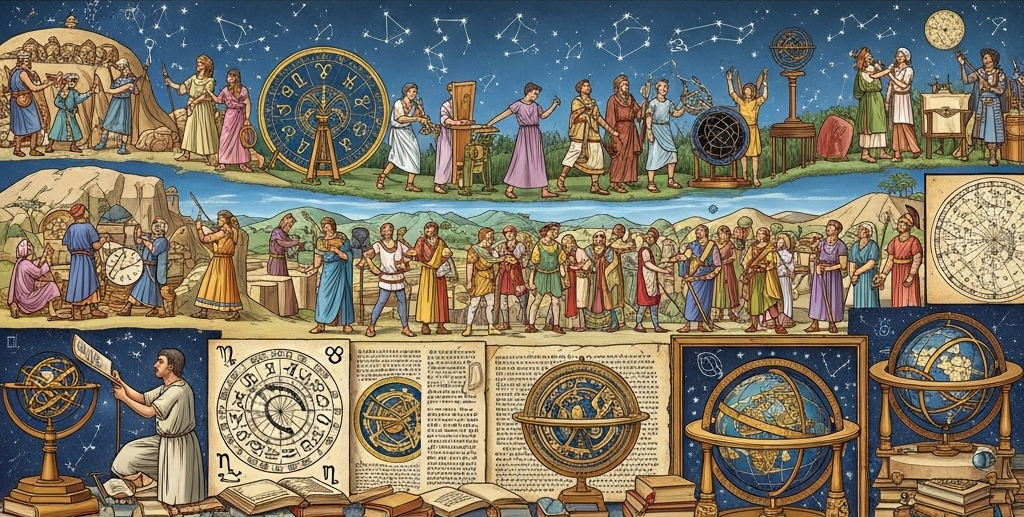
When we discuss Astrology, whether consciously or not, we are also engaging with Astral Theology. It’s widely recognized that most ancient cultures possessed some form of Astral Theology, though not all developed an Astrological Technology. This article specifically focuses on WHERE Astrology originated.
Sumerian/Babylonian Astrology
The fundamental roots of what we currently understand as Astrological technology lie in Sumerian Astral Theology, which some scholars trace back to the V-II Millennium B.C. The Sumerians are credited as the first known civilization to systematically observe the sky, associating their Gods with the planets. Crucially, they maintained written records (on clay tablets) for hundreds of years, documenting planetary movements and earthly events. Their aim was to establish a correspondence link between the two, notably without attributing a cause-effect relationship to this connection.
Thousands of these Sumerian and Babylonian clay tablets are continually being unearthed in excavations. This painstaking, collective effort of direct astronomic observation, spanning hundreds of years, gave birth to the original Omen Astrology.
The core understanding and general premise of this observational work was that events in the skies mirrored events on Earth (planets did not, however, influence events, but rather signaled them). Thus, the Astral Priests sought to discern the patterns of planetary movements to foresee potential events on Earth. They meticulously followed the alignments of major planetary configurations with specific groups of stars.
Centuries later, Babylonian Astronomers/Astrologers further refined the Astrological framework. They introduced zodiacal constellations (12 rows of 3 constellations each, with each constellation residing on one of the three Paths of Anu, Enlil, and Enki—the original source for our Modern Decans). They also maintained accurate astral calendars through more precise mathematical theories and measurements.
Hellenistic Astrology
Greek Astronomers in Ptolemaic Egypt were deeply fascinated by these innovations. (Egypt had been conquered by the Greeks during Alexander the Great’s campaigns in the 3rd Century B.C.; following his death, his generals divided the conquered lands, and Egypt came under the rule of Ptolemy I Soter, who established a “Ptolemaic” dynasty that ruled for three centuries.) These Greek scholars imported the Babylonian System and developed it even further, giving rise to what would become the Foundation for Topical Astrology.
It was at this juncture that the first domification system, Whole Sign domification, was likely developed. At this point, we also see the emergence of planetary attributions, the geometrical doctrine of aspects, and so forth. This new Astrological Framework prioritized the Horoscope (Ascendant) and was subsequently named Horoscopic Astrology (circa V-II century B.C.). Today, we refer to this as Hellenistic Astrology.
This significant Astrological development occurred during a period of major philosophical ferment in Greek thought, specifically the Alexandrian Golden Age. In this “alchemical cooking pot” for Philosophy, Platonic, Aristotelian, and Pythagorean Western thought converged and exchanged ideas with Oriental Philosophy. This intellectual melting pot led to the development of Hermetic Teachings, Neo-platonism, and Neo-pythagoreanism, all of which focused on the Soul, its relationship with the Cosmos, and the overarching framework for the Journey and Destiny of the Soul.
Hellenistic & Indian Astrology
Concurrently, the core technology of Horoscopic Astrology encountered Vedic Astrology. Vedic Astrology already possessed a Ritualistic Astrology technology (Lunar Astrology / Nakshatras), essential for following the ritual indications found in the Vedas. It appears there was an adoption of the Greek Astrological framework (with names translated into Sanskrit), though both traditions remained closer to each other than to Modern Astrology.
Here’s an extract from Robert Schmidt highlighting the differences between the two:
“Indian astrology makes extensive use of the naksatras, which are a division of the zodiac into 27 or 28 portions corresponding to the daily motion of the Moon. Although the ‘lunar mansions’ are known in Medieval Western astrology, they are not found in the original Hellenistic material and seem to have been imported later from India.
Then again, Indian astrology does not have the fivefold irregular division of each sign into ‘bounds’ (called ‘terms’ in Medieval Latin), which is a central concept for Hellenistic astrology.
Indian astrology places far more importance on the lunar nodes than does Hellenistic, almost giving them the status of planets.
Hellenistic astrology has an elaborately developed system of lots (often but mistakenly called ‘Arabic Parts’), which are lacking in Indian astrology proper, although they were introduced later as a result of Persian influence.
Conversely, Indian astrology has an extensive development of divisional (or ‘harmonic’ charts), while Hellenistic basically employed only a version of the twelfth (and possibly thirteenth) harmonic. Then there is the nagging problem of the choice of the beginning of the zodiac, where Indian astrology has various alternative starting points for a sidereal zodiac; by contrast, there is reason to believe that many Hellenistic astrologers—certainly those influenced by Ptolemy—favored a tropical zodiac, although it is still unresolved whether the earliest Hellenistic astrologers used a sidereal or a tropical zodiac.
These two astrologies also differ on quite a number of points of detail. We may never know the full extent of the interaction between Hellenistic and Indian Astrologers, but we can now build a strong case for Hellenistic Astrology as a standalone astrological framework.”
Claudius Ptolemy: Blessing and Curse to Astrology
In the 2nd century A.D., Claudius Ptolemy exerted a major and unique influence on Hellenistic Astrology. As a theoretical scientist working on his unified “theory of Everything,” he adopted the Hellenistic Astrology framework. However, he selectively retained only what he understood (he wasn’t a practicing Astrologer) and what suited his particular worldview.
His fundamental understanding of the world implied that humans living in the “sublunary sphere” received “influences” from the stars (based on Aristotelian principles, notably ignoring the Platonic foundation). He then equated this to a cause-effect relationship (again, Aristotelian thinking) which would subsequently develop into a highly resistant stream of astrological thought.
Ptolemy codified his reasoning in the Astrological treatise Tetrabiblos, which quickly gained immense popularity, to the detriment of other actual Hellenistic Astrological Treatises that were unfortunately lost to history. Until the 1990s, Tetrabiblos was virtually the sole source offering a (heavily skewed) view of Hellenistic Astrology. By then, Hellenistic Astrology had already undergone numerous transformations, culminating in Modern Western Astrology.
The “Thorny” Issue of Tropical vs. Sidereal Zodiac
Most Astrology students eventually grapple with this technical dilemma during their studies, and there are two widely accepted solutions:
- The Tropical Zodiac for most Modern Western Astrology schools.
- The Sidereal Zodiac for most Vedic Astrology Schools.
But what is the root of this dilemma? Let’s try to unravel this zodiacal mystery. Our first clue is the actual difference between the two zodiacal systems. In modern times, this difference amounts to about 24 degrees. In other words, the Tropical Aries ingress corresponds to approximately 5 degrees in Sidereal Pisces. This discrepancy is due to the phenomenon known as the “Precession of the Equinoxes.”
“In astronomy, axial precession is a gravity-induced, slow, and continuous change in the orientation of an astronomical body’s rotational axis. In particular, it can refer to the gradual shift in the orientation of Earth’s axis of rotation in a cycle of approximately 25,772 years. This is similar to the precession of a spinning-top, with the axis tracing out a pair of cones joined at their apices.”
Essentially, the Ingress of the Tropical Aries is relative to the fixed stars background, and fixed relative to Earth’s own axis.
Historically, this wasn’t always an issue. During the development of Horoscopic Astrology in the Ptolemaic era, the two zodiacal systems were largely in sync. It took almost 2000 years for a 24-degree difference to become “noticeable” enough to create technical problems.
In Claudius Ptolemy’s time, the issue of the precession of the equinoxes was already familiar to astronomers and astrologers alike. It was primarily Ptolemy who “decided” on the Tropical Zodiac for the Western world. Most later Hellenistic Astrologers influenced by Ptolemy’s theories followed the Tropical Zodiac.
So, the real question remains: Did the initial Hellenistic Astrologers use the Tropical or Sidereal Zodiac? Since they practically coincided at the time the doctrine solidified, we can’t definitively say. However, what we can do is analyze the recovered Hellenistic Doctrine and put it to the test. Preliminary analyses suggest they may have used both zodiacs, but for different purposes. Perhaps herein lies the key to our answer: they might have employed a combination of both Tropical AND Sidereal frameworks in their astrological work.
Hellenistic Astrology in the Middle Ages
Horoscopic Astrology in the Western world survived in its pure form until the V-VII centuries A.D., evolving into separate streams (Ptolemaic Astrology and Hellenistic Astrology). It then went underground during the Middle Ages due to a loss of interest (influenced by the rise of Christianity, the Inquisition, etc.). Nevertheless, it persisted in a weak stream because Ptolemy’s treatise remained popular among Christian Church officials. Even so, Medieval Astrology was heavily influenced by Christian theology.
From there, actual Hellenistic Astrology resurfaced in the Arabic world. This occurred through the importation and translation of ancient Greek Hellenistic manuscripts during the golden era of Arabic Knowledge Seeking (roughly corresponding to our Middle Ages). These scholarly, open-minded Arabians actually ensured the continuation of Astrological thinking in the Western world.
Astrology in the Renaissance Age
Astrology later re-emerged in Europe during the Renaissance Age when Arabic Astrology treatises (translations of older Hellenistic treatises) were imported and translated into Latin. This happened at a time when Platonic theology was also being rediscovered in Europe, primarily through Marsilio Ficino’s translation efforts, after having been forgotten for centuries.
In the Western world, Astrology was thus revived through the conservative efforts of Arabic scholars and was actually included as curriculum in most universities in Europe during the Renaissance. This period is now referred to as Medieval Astrology (with notable figures like Guido Bonatti, William Lilly, etc.), though its body of knowledge was already influenced by Ptolemy’s Aristotelian reasoning.
(NO) Astrology in the Enlightenment Age
Following the Renaissance, the Enlightenment Age arrived in the West, with its strong emphasis on scientific thinking and materialism. This dealt another significant blow to Astrology in Europe, leading to its further decline. It became largely forgotten, save for the efforts of some brave astrologers who endured public and academic criticism.
Astrology once again went underground, being adopted by certain esoteric groups (such as the Rosicrucian Society, Free Masonry, etc.) who integrated the Astrological (by then, Ptolemaic) framework to describe the journey of the Soul in the Cosmos.
New Astrologies in the Modern Age: Modern Sun Sign Astrology
After the Enlightenment, Astrology barely survived in the public consciousness until the 19th-20th century. It only did so as a greatly simplified Ptolemaic doctrine (representing less than 10% of the original Hellenistic doctrine of the stars). It saw a revival during the Psychological revolution, when it was viewed as a means to unravel the mysteries of the psyche (see Alan Leo).
This is primarily how the Psychological/Personality Astrology framework was born, treating Planets as functions of the Psyche. However, with the “Spiritual enlightenment” of the 19th century and the advent of imported oriental doctrines like reincarnation and karma in the West, Astrology took on another form: Spiritual/Karmic/Evolutionary Astrology, merging these concepts with the existing Personality/Psychology Astrology. This fusion eventually became what we generally perceive today as (modern) Western or Sun Sign Astrology. This modern iteration retains less than 10% of the original, already watered-down (post-Ptolemy) body of Hellenistic Techniques but integrates most 20th Century concepts regarding Personality and Spirituality.
Vedic Astrology During the Ages
In contrast, Vedic Astrology (which retained a large portion of the initial Hellenistic Doctrine) experienced only minor changes. This is largely because the Hindu cultural and spiritual landscape remained relatively stable over the intervening two millennia, explaining the significant gap we observe when comparing Vedic Astrology with Modern Astrology.
Vedic Astrology absorbed the technical doctrines, infused them with its core philosophy regarding the Self & Destiny, and then evolved in its own distinct direction.
Preliminary Conclusions
From this brief introduction to Astrology’s history, it follows that what we call Astrology today originated as a concept from the Sumerians millennia ago. This concept was subsequently developed further by the civilizations that inherited this astral legacy. The core Hellenistic Astrology doctrines have been re-discovered and translated from original Greek Astrological treatises, a process that began in the 1990s with the works of Robert Schmidt, Robert Hand, and others. For more resources and information, you can explore Project Hindsight.