My lifelong passion for Astrology has led me to integrate its study deeply into my life. Early on, I realized I could leverage my professional skills to enhance my learning process. As a project manager, I naturally organize and synthesize large amounts of data to achieve specific outcomes. This led me to approach the study of Astrology as a comprehensive research project.
I began by researching effective ways to study Astrology, focusing on six key areas:
- The Problem of Knowing: How do we truly understand something?
- History of Astrology: Tracing its development and evolution.
- Astrological Theory in Practice: Applying theoretical knowledge and an index of astrological doctrines.
- Philosophical Foundations: Exploring the underlying philosophical principles.
- Problems in Astrology: Addressing common challenges and debates.
- Future of Astrology: Considering its potential trajectory.
If you’re primarily interested in the Index of Astrological Doctrines, you can download it here. Otherwise, read on to explore my perspective on the challenges of studying Astrology.
1. On the Problem of Knowing
I believe true knowledge of something (as opposed to just having information about it) comes from grasping its First Principles—its fundamental roots. These principles define what is being investigated. By identifying and understanding them, you can genuinely comprehend and “know” that particular thing.
These First Principles can be true or false. False principles generally lead to false conclusions or beliefs, while true principles lead to true knowledge. Our minds operate on these principles, often without our conscious awareness. Every thought and concept is sustained by underlying First Principles, many of which we inherit from our environment, education, culture, and media. We can’t truly discern the truth or falsehood of our beliefs, regardless of mainstream views, until we deconstruct them and uncover their foundational principles.
I applied this same concept to Astrology, but in reverse. My initial assumption was that Astrology, and specifically the Planetary-informed Fate Model is True. From there, I systematically worked to uncover the First Principles that must also be true to support this statement. This was a significant challenge for me, given my natural skepticism. However, I understood that a serious study required approaching Astrology from the perspective of its truth rather than its falsehood; making that mental shift was crucial.
My current conjecture is that Astrology’s First Principles are linked to Destiny, Free Will, Time, and the Architecture of the Soul. If Astrology is indeed true, then its First Principles should help us derive true statements about the nature of Destiny and the Soul. This is a profound implication, and I believe Astrology is one of the few (if not the only) disciplines capable of providing verifiable statements through the validity of astrological delineations.

2. History of Astrology
Many modern astrologers are often unaware that Astrology has a rich and complex history, marked by several critical stages and distinct streams, particularly across the Eurasian continent over the past few millennia. This history is vital because it introduces the challenge of potentially multiple sets of First Principles. Do these different astrological traditions share the same fundamental principles, or are they entirely distinct?
Consider the broad historical stages of Astrology in Eurasia:
- Babylonian Astrology → Established the omen-based and mathematical-astronomical foundations of later Western astrology: planetary records, celestial omens, zodiacal schemata, and eventually early forms of natal/horoscopic practice.
- Egyptian Astrology → Contributed decans, sacred calendrical astronomy, temple-cosmological symbolism, and powerful religious models of the soul, afterlife, and cosmic order. Its direct technical contribution to horoscopic astrology is especially visible through the decans, while I maintain that it also supplied the main Nautical Framework that later astrologers employed – a Soul embarking on a boat towards the mysteries of the Cosmos and the afterlife.
- Greek / Hellenistic Astrology → Synthesized Babylonian astronomical-omen material, Egyptian decanal and sacred-cosmological elements, and Greek philosophical/mathematical categories into a new systematic form of horoscopic astrology. This is where Western astrology becomes a coherent doctrine of nativity, fate, houses, lots, aspects, sect, time-lords, and planetary rulership.
- Indian Astrology → Already possessed strong indigenous astral, calendrical, ritual, and nakshatra-based roots from early on, while also absorbing Hellenistic/Greek horoscopic material through Yavana transmission. It developed this material according to Indian metaphysics, karma, dharma, rebirth, ritual timing, varga divisions, daśā systems, and its own spiritual-cultural logic.
- Chinese Astrology → Developed largely independent astral and calendrical systems based on cycles of time, yin-yang, five phases, heavenly stems, earthly branches, lunar mansions, Jupiter-cycle symbolism, imperial omenology, and later fate-calculation systems.
- Persian / Arabic Astrology → Preserved, translated, and transformed the Greek astrological inheritance, while also incorporating Persian, Indian, and Islamic intellectual currents. This tradition was one of the great technical and theoretical re-syntheses of astrology in the West
- Medieval Latin / Renaissance Astrology → Received much of astrology through Arabic-to-Latin translations and scholastic adaptation. It preserved many Hellenistic concepts, but often in altered terminology and with conceptual shifts caused by translation, religious context, and medieval philosophical frameworks.
- Modern Astrology → Recast astrology as a symbolic, psychological, personality-oriented, and developmental language. Its highest systematic expression appears in figures such as Dane Rudhyar, while its most popularized expression is sun-sign astrology. It preserves much of the old technical vocabulary but often detaches it from the original traditional cosmology and doctrine of fate.
While I haven’t explored this in depth, I suspect that most likely the older astral religions of our prehistoric ancestors are the “grandparents” of ancient Astrology, suggesting a common thread yet to be fully investigated.
Historians of Astrology have shown that these stages are not linear developments or an “evolution” of astrological doctrine. Instead, they represent shifts influenced by cultural, philosophical, scientific, political, and religious contexts. (You can read more about its history [here](link to original article’s external history link, if applicable)).
Modern Western Astrology, unfortunately, isn’t the pinnacle of astrological thought; rather, it’s a fragmented collection of of often long-forgotten or misinterpreted knowledge. One cannot derive First Principles from modern, psychologically oriented Astrology. While it can yield secondary principles related to human psychology, these are currently of lesser interest to my research.
The primary goal of my research is to identify the foundational First Principles of Astrology, which I believe are rooted in:
- Babylonian Astrology
- Egyptian Astrology
- Hellenistic Astrology
- Indian Astrology
Later astrological traditions seem to be variations built upon these original principles. I’ve set aside Chinese Astrology for now as a separate category, as I haven’t studied it sufficiently to form a solid opinion.

3. Astrological Theory in Practice
To truly learn Astrology, one must practice it. Before engaging in any practical application, I wanted to ensure a solid grasp of the natal theory I intended to use. My hope was to derive First Principles based on direct experience.
For my learning process, I decided to initially concentrate on Hellenistic Astrology, later moving to Persian/Arabian Astrology. These traditions offer a degree of historical development and consistency. However, this is easier said than done. Many surviving Hellenistic treatises contain fragments of a hypothetical original doctrine attributed to the ancient duo Nechepso and Petosiris.
The challenge lies in how authors throughout history selected, reinterpreted (sometimes incorrectly), and passed down doctrines. When Hellenistic doctrine reached the Arabs, translation and interpretation became even more complex, leading to variations of original concepts (and the excision of much Hellenistic philosophical doctrine). These were then reinterpreted by subsequent authors.
Consequently, pinpointing the original doctrine is incredibly difficult. Yet, recovering the original Hellenistic Astrological system—a blend of Babylonian and Egyptian Astrology with Hellenistic Philosophy—is a key objective of my research. To make sense of the myriad concepts and doctrines in the treatises, I began compiling an Index of Astrological Doctrines. This index has finally allowed me to grasp the full scope of Hellenistic Astrology, and with its completion, I was then truly ready to begin my learning journey.
Index of Astrological Doctrines
The current version of the Index of Astrological Doctrines focuses on Natal Hellenistic Astrology, my primary area of interest. I plan to next index Persian/Arabian works, followed by works from subsequent eras (Medieval, Renaissance, etc.).
This Index contains approximately 250 cross-referenced entries from 35 Hellenistic Astrology treatises. It’s organized by categories and topics, enabling a comparative analysis of a given concept or doctrine across various works, provided you have access to those texts.
The main headings of the Index are:
- Philosophy
- Astronomical Considerations
- Zodiacal Signs
- Planets
- Topical Places (Houses)
- Conception
- Aspect Doctrine
- Lots
- Principles of Chart Synthesis
- General Delineations on Topics
- Predictive Techniques
- Length of Life Techniques
- Miscellaneous lists, tables, etc.

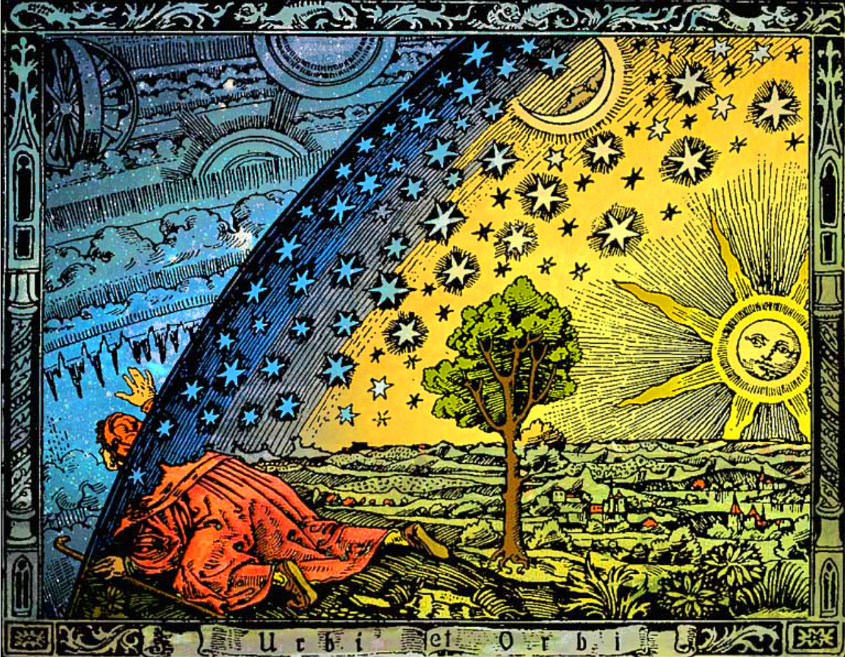
(Or Ancient Philosophers engaging in Astrological Debate, perhaps)
4. Philosophical Foundations
(Original image:
My quest was partly fueled by a personal desire to understand Fate & Free Will as expressed through an astrological doctrine of the soul. I believe such a doctrine can bridge the gap between Plato’s sensible and ideal worlds, as described in his Timaeus.
I started my search with Babylonian Astrology, though literature on it is scarce. Upon moving into Hellenistic Astrology, I quickly realized that any such undertaking requires a strong foundation in several classical philosophical doctrines (at least for the Western tradition):
- Pre-Socratic
- Platonic
- Aristotelian
- Stoic
- Neo-Platonic
(See the [link provided in the original text, if applicable] for a primer on the main philosophical ideas and schools related to Hellenistic Astrology.)
Philosophical inquiry is a prerequisite for this research because the First Principles I’ve mentioned are, in essence, philosophical principles. To recover and then validate or invalidate them, you must first know and understand them, bringing us back to the fundamental “problem of Knowing”.

5. Problems in Astrology
Here’s a summary of challenges anyone undertaking a serious study of Astrology will likely encounter, along with some links for further reading:
- How and why astrology works
- Tropical vs. Sidereal zodiac
- Eastern vs. Western Astrology
- The nature of the Zoidia (signs)
- The problem of House Division
- Destiny & Free Will
- Architecture of the Soul
- Afterlife
- Moment of Incarnation and the descent of the Soul into the body
- Nature of Time
Even before I began this journey, the Tropical versus Sidereal zodiac debate troubled me. To better understand what was at stake, I designed a learning device called the Hermetic Astrolabe. It incorporates elements from Babylonian, Egyptian, Hellenistic, and Indian Astrology. You can learn more about it here.
6. Future of Astrology
Does Traditional Astrology still have a future in this heavily technological and AI-prone society? I think one can still make a case for Astrology, but with certain caveats:
- One must admit to the reality of the Soul (and the corresponding chain of implications)
- One must admit to the reality, or at least possibility, of Fate and Choice (and their subsequent consequences)
In this day and age with 10-second attention span it is quite rare for people to think about Soul, Fate and Choices, there’s no time for these topics, but there may come a time and a place, when Man will find he is completely disconnected from himself, and that’s when we’ll discuss the Future of Astrology.